




“I’ve never felt as essential as I did at that time.”
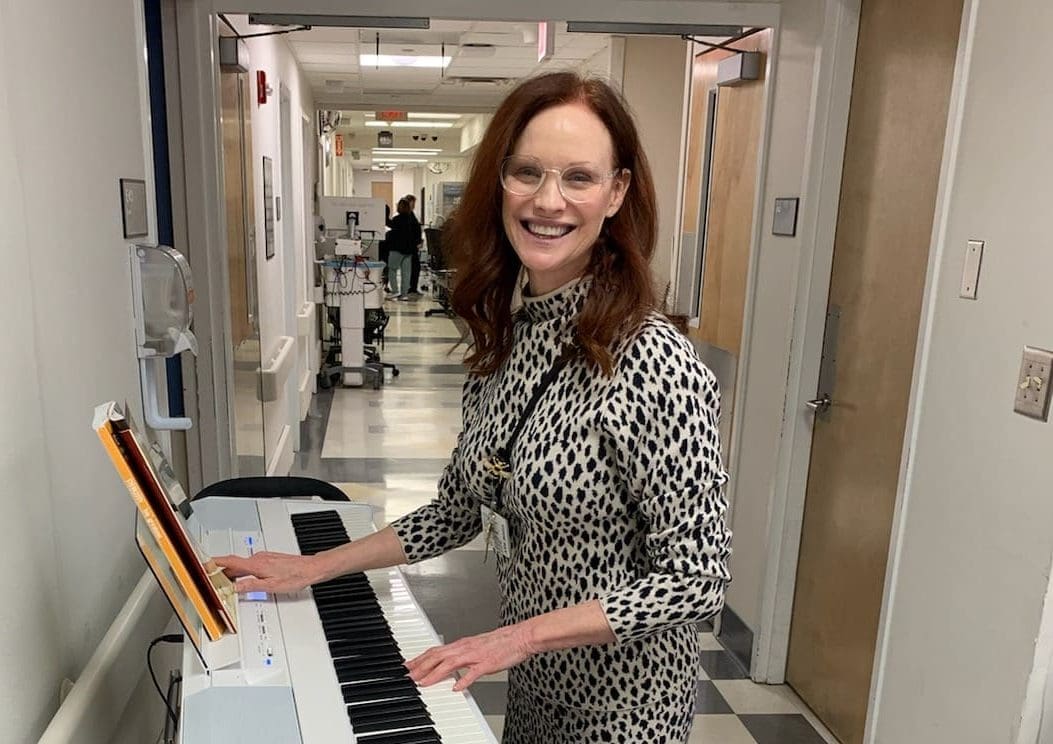
While other therapeutic musicians stepped away from hospitals during the COVID-19 pandemic, Lori Hamrick showed up, daily, instrument in hand. Lori, a pianist newly certified in therapeutic music, willingly made the hour-long commute to Northeast Georgia Health System in Gainesville, Georgia, to provide music for the healthcare workers who were in need of healing themselves.
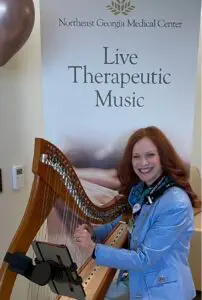 Lori recalls the profound impact her music had on those around her: a thoracic surgeon would ask staff to move away from the computer station closest to her so he could do his charting while listening to her play the piano for nearly an hour at a time. Nurses passing by would stop in their tracks, lean against the nearby wall, and quietly cry as her music filled the halls.
“I was there during those couple of years to fully support the staff on the COVID wards,” Lori reflected. “I realized the power of what music could give, and it motivated me to get up and get there every day. It was incredibly fulfilling.”
Paving Her Own Path
Lori’s journey has been full of surprises and unexpected detours, leading to experiences she wouldn’t have otherwise had if her direction had been more linear.
“I lived a whole life before finding this intersection of talents, interests, and purpose,” she explained.
Every decision Lori made since the early days of her career continued to pave her way toward the intersection of music and medicine. This passion for music and medicine—and music as medicine—led to her current role as a coordinator for the live therapeutic music program at the Northeast Georgia Health System and a student in the online Master of Healthcare Administration program at Wake Forest University School of Professional Studies (SPS).
“I didn’t choose music. I feel like music chose me,” Lori said, recalling some of her earliest memories. “I would sit on my mother’s lap in church and be absolutely captivated by the vibrations that were created first from the organ, and then from the vibrations from my mother’s chest when she would sing. And that’s where it started.”
Lori pursued a bachelor’s degree in music performance as a vocalist, with plans to receive a master’s in music therapy. At the time, she received misleading information that she needed to receive a performance degree first, which redirected the course of her journey.
“After graduating, I worked 10 years in pharmaceutical sales, and I fell in love with the science of it all. I’m grateful for that time because it taught me so much about the body, disease states, and physiology while providing me with invaluable opportunities for professional development,” Lori said.
The time came when she felt a change was necessary, and she chose to step away from the pharmaceutical industry and pursue a new path. Lori returned to music, and spent the next 20 years teaching it independently—a time when she grew significantly as a coach and gained key leadership skills. Then, she felt another call to do more. Ready to pursue a master’s in music therapy, she soon discovered that it required extensive paperwork and offered very little patient interaction.
“Not being able to work directly with patients did not appeal to me at all,” she said.
So, she chose to pivot in search of work that fulfilled her calling to provide healing through music.
Finding Her Frequency at Wake Forest
Lori discovered that a certificate in therapeutic music would allow her to work directly with patients, offering music at the bedside of those facing serious illness. Shortly after earning her certification, a colleague reached out to share the incredible work being done to provide therapeutic music at Northeast Georgia Health System.
“There was so much buy-in and support across the entire organization,” she said. “I joined the team as a live therapeutic musician in October 2019 and ended up working through COVID.”
When her supervisor eventually stepped down, she accepted the role of coordinator—and quickly realized the position had evolved into directing an entire arts in medicine program.
Empowered to fill the gaps in her knowledge to support her new role, Lori began exploring graduate programs in Healthcare Administration, which ultimately led her to Wake Forest SPS.
“I knew a lot about disease states and physiology, and I knew so much about music, but I did not know the landscape of a healthcare system,” she explained. “I didn’t understand the hierarchy, or a lot of the terminology. I was constantly digging and googling, ‘what does this mean?’”
Lori felt deeply inspired to continue growing in her field by Carol Burrell, the recently retired CEO of Northeast Georgia Health System, who led the organization through major expansions and won numerous awards. Lori recalled, “Meeting Carol absolutely expanded my mind on the possibilities of self-development.”
When Lori discovered Wake Forest’s Master of Healthcare Administration program met the standards of the American College of Healthcare Executives, she knew it was the one. “This is my reach for the stars moment,” she said. “Wake Forest has always been a top-tier school in my mind, and I wanted to be the best at whatever I do.”
Her Vision for the Future
Lori’s ultimate goal extends beyond individual patient care.
“Music has always been one of the most powerful ways we communicate with each other. It helps us to express ourselves, process difficult emotions, and cope with our feelings,” Lori said. “I hope our work will help to reinstate the importance of not only music, but also the value the arts bring to the human experience. This is where I found myself, and I’m not ready to stop anytime soon.”
Advance your career with an online Master of Health Administration degree program from Wake Forest University’s School of Professional Studies. Request more information today.